

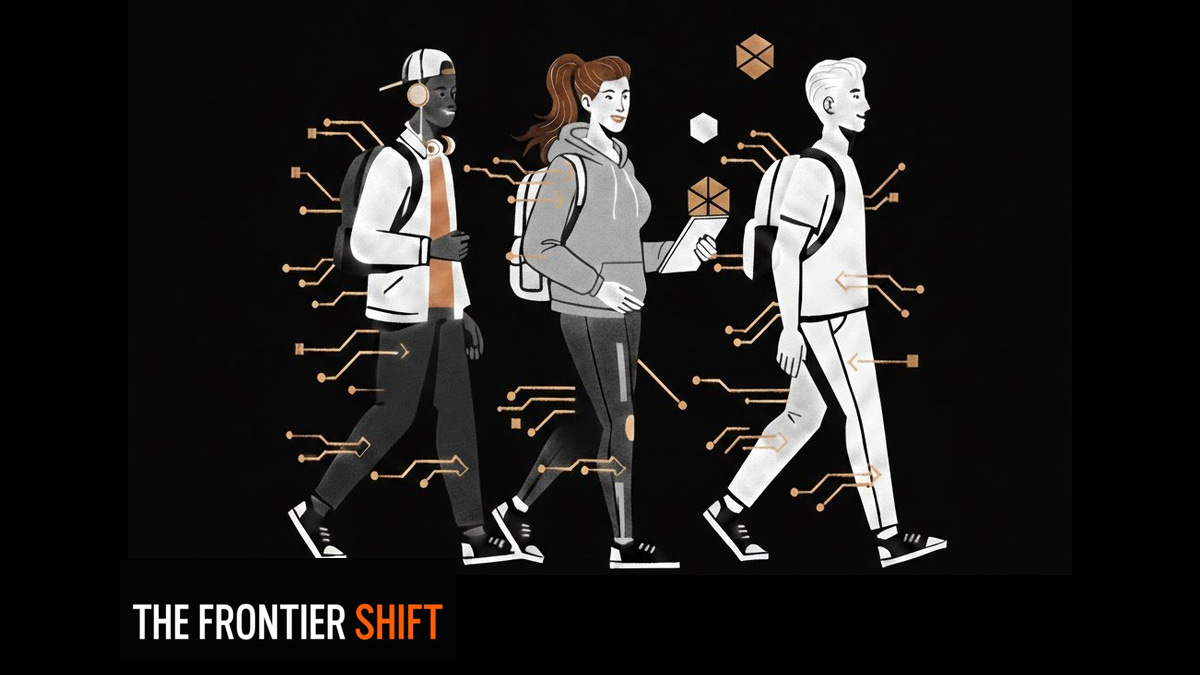
AI will replace 50% of entry-level white-collar jobs in less than five years, according to Anthropic Co-Founder and CEO Dario Amodei.
If you’re a college student reading this, or a parent watching your kid navigate this, you’re probably thinking: '‘Oh shit, now what?”
First, take a deep breath.
Yes, AI is disrupting work and society. But I believe in the spirit, ingenuity, and resilience of humanity. Major technological shifts always create disruption before they create opportunity. AI will be no different.
There may be short-term impact. But the long-term story is one of adaptation, not replacement.
What I’ve Learned in 11 Years
I’ve been at Salesforce for over a decade, working in both professional services and customer success. I’m not a recruiter, but I’ve seen the ebbs and flows of hiring needs both at Salesforce and across dozens of enterprise customers.
Over the years, I’ve had customers ask me to help them understand staffing models for best-in-class teams. E-commerce teams. Digital teams. Centers of excellence. Salesforce practices. Everything in between.
They’ve asked me to craft job descriptions. Review their hiring strategies. Share examples of similar roles at Salesforce.
Here’s what I’ve learned: The jobs that survive aren’t the ones that avoid AI. They’re the ones that embrace it.
The question isn’t whether AI will change your job. It’s whether you’ll be ready when it does.
What I Would Do If I Were in College Right Now
1. Enjoy College
Have fun. Make friends. Explore your interests. Learn about life. Study. Work out. Join clubs. Volunteer. Be an athlete if you are one.
College is about more than job preparation. It’s about becoming a well-rounded person who can think critically, communicate clearly, and adapt to change.
Don’t sacrifice that for AI anxiety.
2. Don’t Freak Out About Your Major
I’ve come to realize that majors don’t matter as much as you think in the real world.
Yes, specialized fields like finance, engineering, or medicine still require specific degrees. But AI is transforming all jobs, not just entry-level ones.
Here’s the important part: Not everyone should go study computer science and artificial intelligence right now.
We need perspectives from all professions. Law. Medicine. Business. Science. English. Sociology. Psychology. History.
In fact, sociology and psychology might be incredibly valuable as the world debates AI safety, transparency, and ethics. We need people who understand human behavior, not just algorithms.
Your major gives you a lens through which to see the world. AI gives you the tools to act on what you see.
3. Get Certified in AI Platforms Now
This is non-negotiable.
Take classes and complete certifications for the following AI platforms:
For everyday work:
Microsoft Copilot (Word, Excel, PowerPoint, Outlook, Teams)
Slackbot (widely used for workplace collaboration)
For coding:
Claude Code (Anthropic)
Codex (OpenAI)
GitHub Copilot (Microsoft)
For business operations:
Salesforce Agentforce (sales, service, marketing automation)
Start here. Explore niche platforms as you discover your career path.
Why these platforms?
You’re probably already using Google Workspace or Microsoft 365 in college. 95% of businesses use one or the other. You will use their AI tools regardless of your industry.
Claude Code, Codex, and GitHub Copilot are becoming the new standard for AI-assisted development. Even if you’re not a developer, understanding how AI writes code will give you an edge.
Many companies use Slack for collaboration and Salesforce for business operations. Learning these platforms now means you’ll hit the ground running.
Good news for college students: Microsoft offers 12 months of free Microsoft 365 Premium and LinkedIn Premium Career for verified students. Take advantage of it.
These aren’t just tools. They’re the infrastructure of modern work.
4. Build Something, Anything
This is where you prove you can execute.
Build a small e-commerce site selling something you’re passionate about. Create an AI chatbot that answers questions about your favorite topic. Start a newsletter analyzing trends in your field of study. Use AI to create content (videos, graphics, music) and share your process. Build a simple app or tool that solves a problem you personally have.
The goal isn’t perfection. It’s proof.
Proof that you can learn new tools independently, create something from nothing, communicate ideas effectively, and stick with a project over time.
When recruiters look at your profile, they’re not just looking for credentials. They’re looking for evidence that you can execute.
Building something, anything, shows you can.
5. Make LinkedIn Your Home Base
Yes, you can have a separate newsletter on Substack or another platform. But that’s one more thing to maintain while you’re juggling classes, internships, and everything else.
LinkedIn is your professional home base. Here’s what you need:
Profile essentials:
A nice, smiling profile picture
A clear “About Me” section with your goals
Any work experience or internships
Your education
Certifications as you earn them
Content strategy: Write about what you’re learning. Share what you’re building. Document your progress.
The goal is to make your profile feel vibrant and catch the attention of recruiters.
Does this sound like a lot of work on top of everything else?
It is.
But it will absolutely help you find a job.
Pace yourself. This is all worth it.
The Most Important Thing to Remember
“AI Won’t Replace Humans—But Humans With AI Will Replace Humans Without AI”
—Harvard Business School Professor Karim Lakhani
The future doesn’t belong to people who fear AI.
It belongs to people who learn to work with AI. Who understand its capabilities and limitations. Who can translate business problems into AI-assisted solutions.
That person can be you.
But only if you start now.
Final Thoughts
I’m optimistic about the future. Not because AI won’t disrupt jobs, but because humans have always adapted to technological disruption.
The printing press didn’t eliminate writers. It created more of them.
The calculator didn’t eliminate accountants. It freed them to do higher-level analysis.
AI won’t eliminate knowledge workers. It will redefine what knowledge work looks like.
The question is: Will you be ready?
About Me
I’m Phil Nowak, a Lead Principal Customer Success Manager at Salesforce, where I’ve spent 11 years working with multi-billion dollar global companies across nearly every industry.
I’m a graduate of MIT’s Artificial Intelligence Business Strategy program, Salesforce’s Accelerate Leadership Program, and I majored in Economics with a Business Minor at Indiana University Bloomington. Go Hoosiers!
I write The Frontier Shift to help people understand how technology, capital, and infrastructure are actually reshaping the world.
Feedback? Reply to this email, send me a message, or connect with me below.
LinkedIn | X | Subscribe | 📍 Chicago
Views expressed are my own.