

🔹 The Quick Pulse
The AI arms race is accelerating. Washington is fighting over who controls AI regulation, model releases are leapfrogging each other, and society is starting to confront what a world looks like as intelligence becomes cheap, abundant, and increasingly autonomous. The pace is the signal.
🔹 The Big Three
1. White House issues a National AI Policy Framework
What happened:
The White House released a national framework aimed at asserting federal authority over AI policy, preempting state-level regulation.
Why it matters:
This sets up a direct federal vs. state power struggle. The left is pushing back on federal overreach. The right is split, with parts of MAGA resisting centralized control despite backing AI acceleration. Regulation will move slower than the technology, but this is the opening shot.
Related:
The Left Fights Back - President Trump’s AI National Policy Executive Order Is an Unambiguous Threat to States Beyond Just AI
Related:
The Right Fights Back Too - Inside MAGA’s growing fight to stop Trump’s AI revolution
2. OpenAI releases GPT-5.2
What happened:
OpenAI shipped GPT-5.2, pushing further into reasoning, autonomy, and enterprise-grade reliability.
Why it matters:
This isn’t about benchmarks. It’s about land grab. Each major release is designed to lock in daily usage across work, education, and life before regulators or competitors can slow things down. OpenAI also published its State of Enterprise AI 2025 report, signaling where revenue and adoption are already heading.
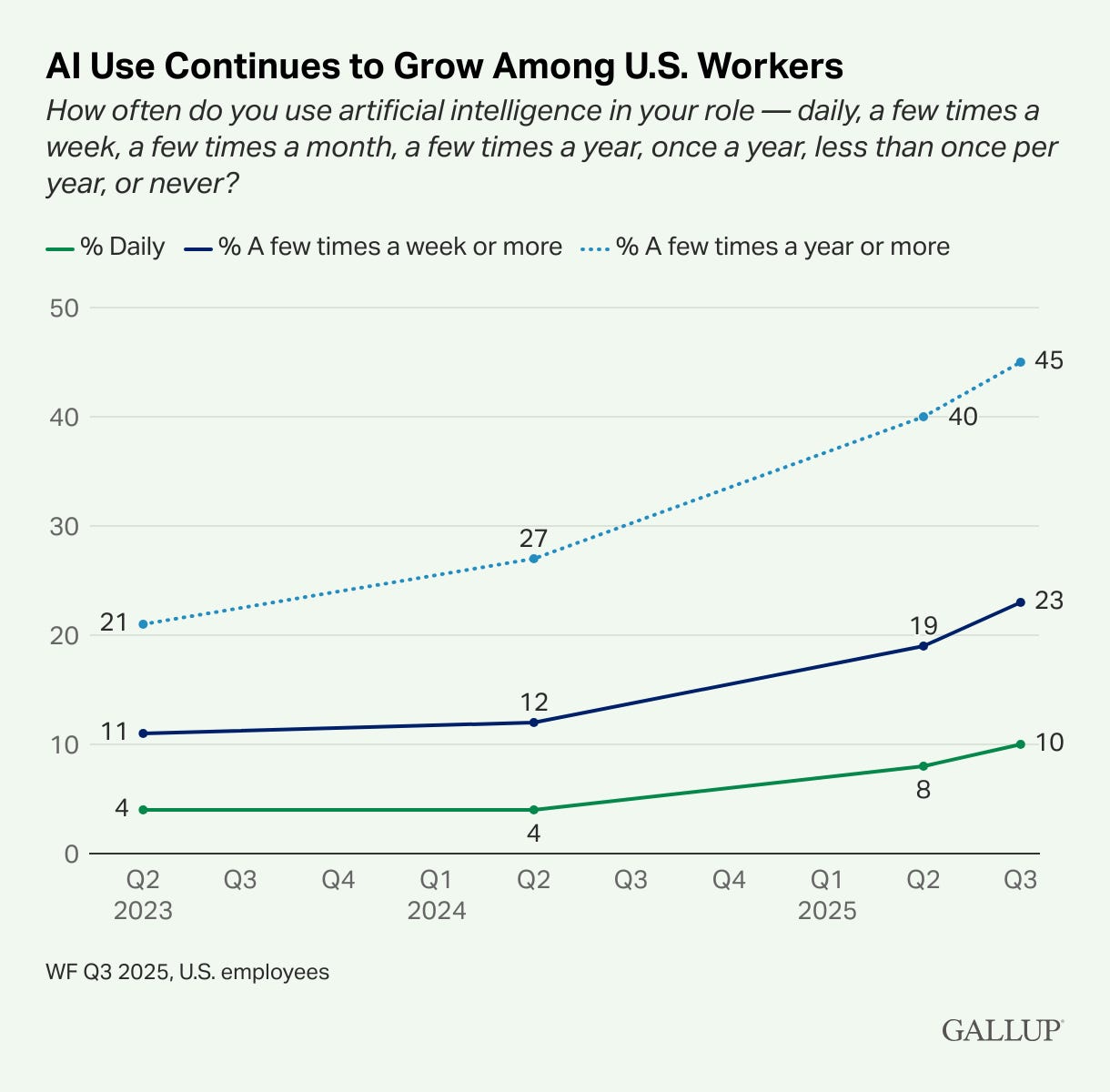
3. New Gallup data shows AI use at work is rising fast
What happened:
Gallup released new data showing a sharp increase in AI usage among workers, especially knowledge workers.
Why it matters:
This confirms AI adoption is no longer experimental. It’s becoming ambient. Tools that save time win. Managers may not mandate AI yet, but employees are already using it quietly to stay competitive.
📈 Trendline
Zoom out. We are still early.
AI laws and regulations will take years to negotiate, and that’s just in the U.S.
Global alignment is a decade-long problem, if ever.
Sam Altman is reportedly exploring space-based infrastructure ideas, including data centers in orbit, to solve long-term AI power and compute constraints. That sounds extreme until you realize energy is the real bottleneck.
Utilities and governments are reviving nuclear power projects because AI workloads demand always-on, massive, reliable energy. This is infrastructure, not software.
🎙️ The Soapbox
With midterm elections approaching, expect the White House to accelerate efforts to impose federal AI rules that override the states. This will get messy.
While politicians argue on Capitol Hill, in courts, and across cable news, AI companies will keep spending billions to ship models faster. Every release is another stake in the ground. The goal is simple: make AI indispensable before anyone can stop it.
This playbook isn’t new. Uber ran it perfectly. Travis Kalanick pushed aggressive market entry, subsidized adoption, and fought regulators city by city. By the time governments reacted in force, Uber was already the default. AI companies are doing the same thing, just at global scale.
The unresolved question is who becomes the villain.
If society gets addicted to AI-driven productivity, politicians will eventually back down or get voted out. But if AI displaces millions of jobs without credible paths for reskilling, hybrid work, or income support, expect European-style bureaucracy to clamp down hard.
💬 Quoteworthy
“AI is now infrastructure, and this infrastructure, just like the internet, just like electricity, needs factories. They’re not data centers of the past. They are, in fact, AI Factories. You apply energy to it, and it produces something incredibly valuable called tokens.” - Jensen Huang, CEO of NVIDIA
🧩 Explained Simply
The Technological Singularity
Coined by futurist Ray Kurzweil, this describes a point where AI surpasses human intelligence and begins improving itself faster than humans can understand or control. The outcome isn’t clearly good or bad. It’s unknown. That uncertainty is the point.
🔭 Forward Signal
The real inflection arrives in 2026. That’s when companies and individuals stop experimenting and start posting massive revenue numbers driven directly by AI. Expect the first billion-dollar company built by a solo founder or tiny team, possibly a teenager, operating out of a bedroom. It may already exist privately.
About Me
I’m Phil Nowak, a Lead Principal Customer Success Manager at Salesforce, where I’ve spent 11 years working with multi-billion dollar global companies across nearly every industry.
I’m a graduate of MIT’s Artificial Intelligence Business Strategy program, Salesforce’s Accelerate Leadership Program, and I majored in Economics with a Business Minor at Indiana University Bloomington. Go Hoosiers!
I write The Frontier Shift to help people understand how technology, capital, and infrastructure are actually reshaping the world.
Feedback? Send me a message or connect with me below.
LinkedIn | X | Subscribe | 📍 Chicago
Views expressed are my own.