

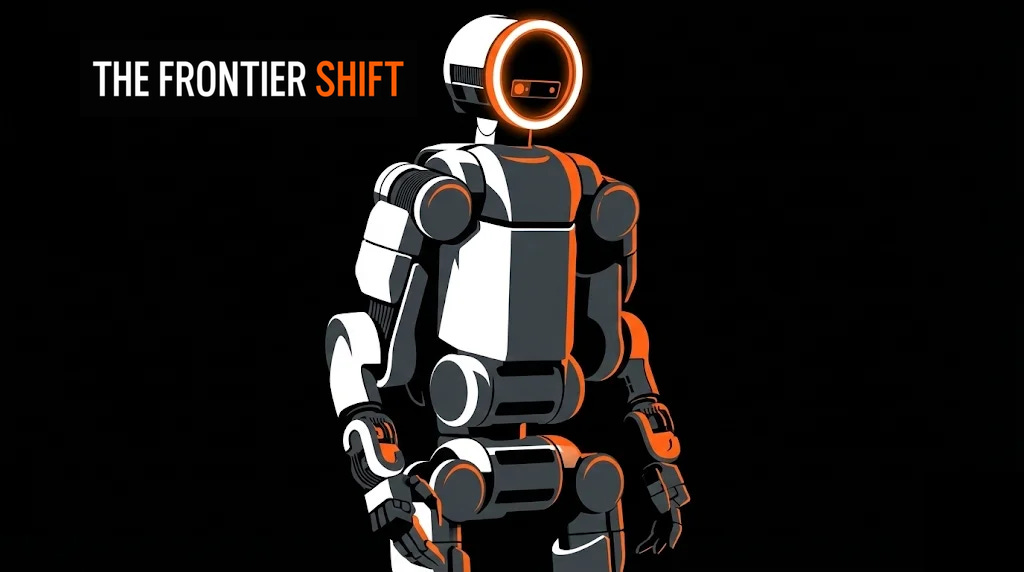
The Signal
Humanoid robots are moving from lab demos to real industrial deployment. Boston Dynamics’ new Atlas marks the shift from research prototype to production-grade worker robot.
The Big Deal
What Happened
Boston Dynamics unveiled a fully electric, production-ready Atlas humanoid robot designed for real industrial environments. Manufacturing has already begun, with first deployments planned for 2026.
This is not a concept video.
It’s a commercial robot built to work.
Why It Matters
Atlas represents a step change in how physical labor, automation, and AI intersect.
Key points:
Production-ready: Atlas is no longer a research platform. Boston Dynamics is actively building units for deployment.
Industrial focus: Early use cases include manufacturing, logistics, and material handling.
Autonomy at work: Atlas can learn tasks quickly, adapt to changing environments, navigate facilities, and manage its own charging.
AI integration: A partnership with Google DeepMind brings advanced AI models into physical robots, not just software.
Backed by scale: Hyundai is investing heavily in robotics manufacturing capacity, aiming for large-scale production over time.
Plain English
The Boston Dynamics Atlas robot is no longer science fiction.
It’s already in production and working inside a Hyundai car manufacturing facility in Georgia. Hyundai plans to manufacture up to 30,000 Atlas humanoid robots per year by 2028.
That’s not experimentation. That’s industrial scale.
The Frontier Shift
This isn’t about replacing every worker overnight.
It’s about where labor shortages, safety risks, and repetitive physical work converge. Humanoid robots fit existing human environments without requiring entire facilities to be rebuilt.
For the first time, these aren’t just robots on a stage. They’re ready to be deployed.
Forward Signal
What to Watch Next
Cost curves and unit economics
How quickly robots learn new tasks on the job
Where human-robot collaboration works, and where it doesn’t
This is what the early innings of AI look like in real-world physical applications.
About Me
I’m Phil Nowak, a Lead Principal Customer Success Manager at Salesforce, where I’ve spent 11 years working with multi-billion dollar global companies across nearly every industry.
I’m a graduate of MIT’s Artificial Intelligence Business Strategy program, Salesforce’s Accelerate Leadership Program, and I majored in Economics with a Business Minor at Indiana University Bloomington. Go Hoosiers!
I write The Frontier Shift to help people understand how technology, capital, and infrastructure are actually reshaping the world.
Feedback? Send me a message or connect with me below.
LinkedIn | X | Subscribe | 📍 Chicago
Views expressed are my own.